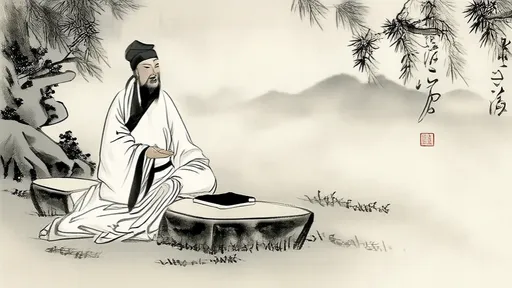
In the hushed halls of Western museums, Chinese literati painting often occupies a quiet corner, its subtle monochromes and seemingly simplistic compositions easily overshadowed by the vibrant dramas of European oil paintings. To the untrained eye, these works might appear as mere historical artifacts or skilled exercises in brushwork. However, to dismiss them as such is to miss the profound universe contained within their ink-washed boundaries. These are not merely pictures; they are philosophical arguments rendered in ink, silent poems whispered on paper, and the most intimate portals into the soul of a millennia-old civilization.
The very term ‘literati painting’ or wenrenhua (文人画) signifies a radical departure from the artistic conventions that preceded it. For centuries, Chinese painting was largely the domain of professional court painters, whose technical virtuosity was employed in the service of emperors and nobles to create detailed, colorful, and often narrative-driven works. The emergence of the scholar-amateur painter during the Northern Song Dynasty (960–1127) represented a seismic shift. These were men—and they were almost exclusively men—of letters: government officials, poets, and philosophers for whom painting was not a profession but a form of personal cultivation, a private dialogue with nature and the self. Their art was an extension of their intellectual and spiritual life, a ‘mind painting’ rather than a mere ‘hand painting’. The goal was not to replicate the external appearance of a mountain or a tree with photographic accuracy, but to capture its essential spirit, its qi (气), and in doing so, to express the inner landscape of the artist's own mind.
This pursuit led to an aesthetic philosophy that prized spontaneity, understatement, and a certain rustic clumsiness over polished technique. A perfectly executed but soulless depiction was considered inferior to a work that, while perhaps technically flawed, vibrated with the authentic energy and intention of the artist. This is where the concept of yipin (逸品), often translated as the ‘untrammeled class’ or ‘free-spirit style’, became the highest ideal. It championed the eccentric, the spontaneous, and the intuitively expressive, seeing in these qualities a truer reflection of the Dao, the ineffable way of the universe. The painter was not a craftsman but a conduit, and the brushstroke became the physical trace of a moment of spiritual and mental unity. To understand this art, one must first grasp the triumvirate of Chinese thought that forms its bedrock: Confucianism, Daoism, and Chan (Zen) Buddhism. Each contributed a distinct voice to the chorus of literati philosophy. Confucianism provided the moral and social framework. For the scholar-official, painting was an act of self-cultivation aligned with the Confucian ideal of the junzi (君子), the virtuous gentleman. It was a practice that nurtured integrity, harmony, and a sense of duty to the cosmic order. The balance and structure inherent in many compositions reflect this Confucian desire for harmony and propriety. If Confucianism provided the structure, Daoism provided the escape valve. It was the Daoist love of nature, spontaneity, and freedom from artificial societal constraints that truly liberated the literati brush. Daoist philosophy encouraged the artist to seek union with the Dao by immersing themselves in, and becoming one with, the natural world. The iconic shanshui (山水, mountain-water) landscapes are not topographical records but idealized, internalized realms where the human figure is minuscule, almost insignificant. These vast, misty panoramas are meditative devices, inviting both the artist and the viewer to wander spiritually, to lose themselves in the eternal, breathing cosmos. They visualize the Daoist principle of wuwei (无为), or effortless action, where the painter’s hand moves not by conscious will but in spontaneous harmony with the natural force flowing through them. Later, Chan Buddhism infused literati painting with its potent emphasis on direct, intuitive insight and the rejection of rigid dogma. The Chan belief in achieving enlightenment in a flash of awareness resonated deeply with the aesthetic of spontaneity. The swift, decisive, and unrepeatable ink stroke became analogous to the sudden awakening of the Chan mind. Painting, like meditation, became a path to seeing the world as it truly is, unmediated by intellectual constructs. This fusion of thought created a unique artistic paradigm where the act of creation was itself a form of philosophical inquiry and spiritual practice. The tools of this practice—ink, brush, and paper—were known collectively as the Four Treasures of the Study. Their materiality is crucial to understanding the art. The grindstone, the water, and the solid ink stick require a ritual of preparation that forces a pause, a settling of the mind before a single mark is made. This ritual is the first step into a meditative state. The rabbit-hair or wolf-hair brush is incredibly sensitive, an extension of the artist's nerve endings, capable of transmitting the slightest tremor of intention onto the paper. Xuan paper, absorbent and unforgiving, demands absolute certainty and fluency; there is no room for hesitation or correction. This technical challenge is not a barrier but a necessary condition, a discipline that weeds out the unprepared mind and ensures that only a pure and focused intention can leave its mark. And what a mark it is. The brushstroke is the fundamental unit of meaning in literati painting. Beyond delineating form, it is a complete repository of information about the artist's state of being in the moment of creation. The varying pressure, speed, moisture, and angle of the brush create a vocabulary of strokes that the educated viewer can read like a emotional fingerprint. A dry, scratchy stroke might convey the rugged, aged quality of a cliff face and, simultaneously, the artist's own austere and resolute character. A swift, wet, spreading stroke might evoke the lushness of a summer leaf and the painter's spontaneous joy. This is the concept of bimo (笔墨), where ‘bi’ (brush) represents the bone structure, the masculine yang energy, and ‘mo’ (ink) represents the flesh, texture, and feminine yin energy. Mastery lies in their perfect, dynamic balance. Perhaps the most telling feature of literati painting’s philosophical depth is its intimate relationship with the other arts of the scholar’s studio: poetry and calligraphy. These were never considered separate disciplines but integrated branches of the same expressive tree. The practice of inscribing a poem directly onto the painting surface transforms the artwork into a complete multimedia expression. The poem does not merely describe the image; it amplifies its mood, reveals a hidden layer of meaning, or records the circumstance of its creation. The calligraphy itself, with its own aesthetic rhythm and energy, becomes a visual element within the composition, its abstract forms dancing in balance with the painted forms. The combined seals of the artist and collectors add a final layer of history and provenance, turning the painting into a living document passed down through generations of like-minded connoisseurs. Ultimately, the empty space—the unpainted, blank areas of the paper—is as eloquent as the ink itself. This is not negative space or a simple background; it is a profound philosophical statement. It represents the void from which all things emerge, the silent pause between musical notes, the fertile nothingness of the Dao. It is mist, cloud, water, sky, and infinity. It invites the viewer into the painting, not as an observer but as a participant, to complete the scene with their own imagination and to wander in the vastness between the mountains. This use of space is a direct challenge to the Western tendency to fill the entire canvas. It is a visual manifestation of the belief that true fullness often resides in emptiness, and that meaning is found as much in what is unsaid and unseen as in what is explicitly presented. In a contemporary world saturated with high-resolution imagery and frantic visual stimuli, the quiet, demanding art of Chinese literati painting offers a radical alternative. It asks for patience, cultural literacy, and contemplative engagement. It refuses to shout its meaning, preferring to reveal it slowly to those willing to learn its language. To engage with a work by Ni Zan or Huang Gongwang is to enter into a silent conversation with a mind from across the centuries, a mind concerned not with capturing a fleeting moment of light, but with expressing eternal verities about humanity's place in the cosmos. The bamboo bending in the wind is more than a plant; it is a lesson in resilience. The lonely hut in a vast mountain range is more than a dwelling; it is a state of mind. In these ink-washed worlds, we find not a escape from reality, but a deeper, more philosophical way of seeing it. The true subject of the painting was never just the landscape; it was always the human spirit contemplating it.
By /Aug 28, 2025
By /Aug 28, 2025
By /Aug 28, 2025

By /Aug 28, 2025
By /Aug 28, 2025
By /Aug 28, 2025

By /Aug 28, 2025

By /Aug 28, 2025
By /Aug 28, 2025
By /Aug 28, 2025
By /Aug 28, 2025
By /Aug 28, 2025
By /Aug 28, 2025
By /Aug 28, 2025
By /Aug 28, 2025
By /Aug 28, 2025
By /Aug 28, 2025
By /Aug 28, 2025
By /Aug 28, 2025
By /Aug 28, 2025