The soft morning mist hangs over the haystacks as the first rays of sunlight begin to pierce through, casting ever-changing hues of gold and violet across the countryside. This transient moment, this fleeting dance of light and color, became the very essence of what we now celebrate as Impressionism—a movement that forever altered the course of art history. The revolution did not begin in grand studios with controlled lighting and meticulous setups, but rather in the open air, where artists embraced the unpredictable, the momentary, and the vibrantly real.
Before the Impressionists emerged in the late 19th century, the art world was dominated by the rigid conventions of the Académie des Beaux-Arts in Paris. History paintings, religious scenes, and portraits of the elite were considered the highest forms of art, all executed with precise lines, subdued palettes, and idealized compositions. Artists typically worked indoors, using sketches made outdoors as mere references, often losing the spontaneity and vitality of the original scene in the process. The studio was a place of control, where light could be manipulated and details could be perfected, but it was also a cage that limited the artist's connection to the immediacy of nature.
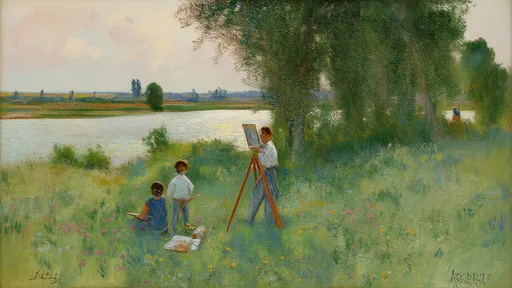
Everything changed when a group of rebellious artists—including Claude Monet, Pierre-Auguste Renoir, and Camille Pissarro—began to challenge these norms. Rejecting the traditional methods, they took their easels, canvases, and paints directly into the fields, forests, and streets. They sought to capture not just the physical appearance of a scene, but the very atmosphere that enveloped it—the way light danced on water, how shadows shifted with the passing clouds, and the subtle interplay of colors in natural settings. This was not merely a change in technique; it was a philosophical shift towards authenticity and sensory experience.
Central to this transformation was the development of plein air painting. The term, French for "open air," became synonymous with the Impressionist approach. By working outdoors, artists could observe and render the effects of light and weather in real-time. They learned to paint quickly, using broad, loose brushstrokes to convey movement and change. This method required a new kind of discipline—one that valued perception over precision, and emotion over exactitude. The canvas became a record of an experience, a moment frozen in time, yet pulsating with life.
Technological advancements played a crucial role in enabling this outdoor revolution. The invention of portable easels and collapsible paint tubes allowed artists to carry their supplies conveniently into the field. Before this, paints were stored in pig bladders or glass syringes, making them cumbersome and difficult to transport. The new tin tubes, pioneered by John Goffe Rand in the 1840s, not only made paints more portable but also kept them fresh for longer periods. This innovation gave artists the freedom to work spontaneously and explore remote locations without being tethered to the studio.
Moreover, the expansion of the railway system in France provided artists with greater access to the countryside. Villages like Barbizon and later Giverny became hubs for artists seeking refuge from the city's chaos. These locations offered diverse landscapes—from rugged forests to serene riversides—that inspired countless masterpieces. The ability to travel easily meant that artists could chase the light, following the sun throughout the day to capture its varying effects on the land.
The Impressionists' focus on light and color was also fueled by scientific discoveries of the time. Studies in optics and color theory, such as those by Michel Eugène Chevreul, revealed how colors interact and influence one another. Instead of mixing pigments on the palette, artists began applying pure, vibrant strokes of color directly onto the canvas, allowing the viewer's eye to blend them from a distance. This technique, known as optical mixing, created a luminosity that was previously unattainable. Shadows were no longer rendered in black or gray but in complementary colors, making them feel alive and integrated into the overall harmony of the piece.
Monet’s series paintings—such as his Haystacks, Rouen Cathedral, and Water Lilies—exemplify this deep fascination with light’s transformative power. In these works, he returned to the same subject at different times of day and under varying weather conditions, exploring how light could alter perception and mood. Each canvas tells a unique story, not of the object itself, but of the light that defines it. This repetitive yet innovative approach underscored the belief that reality is not fixed but fluid, shaped by moments of visual poetry.
However, the path to acceptance was fraught with challenges. The Impressionists faced harsh criticism from the art establishment, which dismissed their work as unfinished, chaotic, and even heretical. The term "Impressionism" itself was originally coined as an insult by critic Louis Leroy, who derided Monet’s Impression, Sunrise as a mere sketch rather than a completed painting. Yet, the artists embraced the label, turning criticism into a badge of honor. They organized independent exhibitions outside the official Salon, creating a platform for their radical visions and gradually attracting a audience that appreciated their fresh perspective.
The legacy of Impressionism extends far beyond its initial shock value. It paved the way for modern art by breaking from tradition and emphasizing individual perception. Movements such as Post-Impressionism, Fauvism, and even Abstract Expressionism owe a debt to these pioneers who dared to see the world differently. Their emphasis on capturing the ephemeral—the play of light, the whisper of wind, the warmth of the sun—reminds us that beauty often lies in transience, and truth in the act of seeing anew.
Today, the Impressionist commitment to outdoor painting continues to inspire artists around the world. Whether in urban parks or remote wilderness, the practice of plein air remains a testament to the enduring power of nature as a source of creativity. It invites us to step outside, to observe closely, and to find wonder in the everyday interplay of light and color. In a world increasingly dominated by screens and virtual experiences, this connection to the tangible, sensory world feels more vital than ever.
The haystacks may have weathered away, and the cathedrals may have aged, but the light that Monet and his contemporaries captured continues to shine through their canvases, inviting us to pause and see the world through their eyes—a world alive with color, vibrating with light, and forever changing in the embrace of the open air.
By /Aug 28, 2025
By /Aug 28, 2025

By /Aug 28, 2025

By /Aug 28, 2025
By /Aug 28, 2025

By /Aug 28, 2025

By /Aug 28, 2025

By /Aug 28, 2025
By /Aug 28, 2025
By /Aug 28, 2025
By /Aug 28, 2025

By /Aug 28, 2025
By /Aug 28, 2025

By /Aug 28, 2025
By /Aug 28, 2025

By /Aug 28, 2025

By /Aug 28, 2025
By /Aug 28, 2025
By /Aug 28, 2025

By /Aug 28, 2025