In the dimly lit galleries of mid-20th century New York, a revolution was quietly unfolding on canvas. Abstract Expressionism emerged not merely as an art movement, but as a profound psychological and philosophical statement—a raw, unfiltered conversation between pigment and psyche that forever altered our understanding of artistic expression. The canvas became an arena where emotion, rather than representation, took precedence, where the very act of painting transformed into a performance of inner turmoil and ecstasy.
The post-war atmosphere provided fertile ground for this artistic upheaval. As the world grappled with the aftermath of unimaginable destruction and the looming shadow of nuclear annihilation, traditional artistic forms seemed inadequate to express the complex emotional landscape of the era. Artists began looking inward, exploring the depths of human consciousness through radical new approaches to paint application, composition, and color. The resulting works weren't meant to be understood through intellectual analysis but felt through visceral, emotional response.
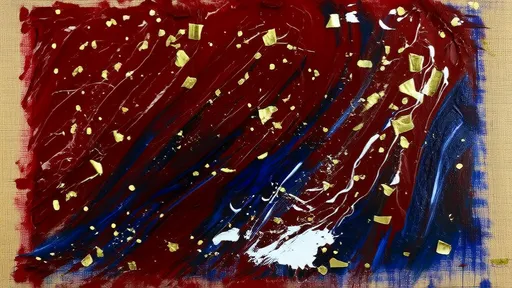
Jackson Pollock's drip paintings exemplify this transformative approach. His method of laying canvases on the floor and dancing around them with paint cans represented a complete break from conventional painting techniques. The resulting webs of enamel and aluminum paint weren't merely decorative patterns but physical records of artistic movement and emotional intensity. Each splatter, each flung droplet, captured a moment of creative decision-making that bypassed conscious planning in favor of intuitive expression.
What made Pollock's technique particularly revolutionary was its embrace of accident and spontaneity. Unlike the carefully planned compositions of previous artistic movements, Abstract Expressionists welcomed the unexpected outcomes of their process. The paint itself became an active participant in the creative dialogue—its viscosity, its absorption into the canvas, its unpredictable behavior when flung or poured all contributed to the final emotional impact of the work.
Mark Rothko pursued a different but equally profound approach to emotional expression through paint. His signature multiform paintings—large canvases featuring soft-edged rectangles of color stacked against colored backgrounds—created immersive visual experiences that seemed to pulsate with inner light. Rothko meticulously mixed his pigments using ancient techniques, creating colors that appeared to glow from within the canvas. The emotional power of these works emerges from their subtle color relationships and the meditative space they create between painting and viewer.
The physical scale of Rothko's works was crucial to their emotional impact. By creating paintings that often measured over two meters in height, he surrounded viewers with color, creating an environment rather than merely presenting an image. This monumental scale forced an intimate relationship between viewer and artwork—one couldn't simply observe a Rothko painting from a distance; one had to stand before it, to be enveloped by its color field, to experience its emotional resonance physically and psychologically.
Willem de Kooning brought a different emotional vocabulary to Abstract Expressionism through his aggressive, visceral approach to the figure. His famous Woman series, with its distorted, almost violent representations of the female form, channeled raw psychological energy through dramatic brushwork and clashing colors. De Kooning maintained a tension between abstraction and representation that created powerful emotional dissonance—his figures seem to emerge from and disintegrate back into the paint itself, embodying the struggle between form and formlessness.
The emotional intensity of de Kooning's work came from his physical engagement with the canvas. He would scrape away, rework, and aggressively manipulate the paint surface, building up layers that recorded both creative decisions and their subsequent rejections. This palimpsest approach created paintings that vibrate with pent-up energy, their surfaces becoming archaeological records of artistic struggle and emotional turmoil.
Color theory took on new significance in Abstract Expressionist works, with artists using color not descriptively but emotionally. Barnett Newman's zip paintings used vertical bands of color to create spatial tension and emotional resonance. His extensive writings reveal his belief that color could access primal emotional states and create what he called "a living thing, a vehicle for an abstract thought-complex." The stark simplicity of his compositions belied their sophisticated emotional impact.
The materials themselves became carriers of emotional meaning in Abstract Expressionist works. Artists experimented with new synthetic paints, mixing media, and unconventional tools to achieve specific emotional effects. The thickness of impasto, the transparency of washes, the gloss of enamel, and the matte quality of acrylics all contributed to the emotional vocabulary of these works. Paint was no longer merely a means to represent something else—it became the thing itself, with its physical properties carrying emotional weight.
The critical reception of Abstract Expressionism reveals much about its emotional power. Early critics struggled to find language adequate to describe works that operated outside traditional narrative and representational frameworks. They turned to metaphors of creation, destruction, and transcendence—language typically reserved for religious experience. This difficulty in categorization itself speaks to the movement's success in accessing pre-verbal emotional states that resist easy explanation.
The legacy of Abstract Expressionism continues to influence contemporary art practices that seek to bridge materiality and emotion. Today's artists working with poured resins, pigment suspensions, and other experimental media owe a debt to these mid-century pioneers who demonstrated how materials could become direct conduits for emotional expression. The movement established that the most powerful art often operates not through what it represents but through what it evokes—the unconscious emotional responses triggered by color, form, and materiality.
Recent neurological studies have begun to validate what Abstract Expressionists intuitively understood about emotional communication through art. Brain imaging research shows that abstract art activates different neural pathways than representational art, often engaging areas associated with emotion and internal thought more directly. The ambiguity of abstract works appears to stimulate longer viewing times and more personal emotional connections, as viewers project their own meanings and feelings onto the open-ended visual information.
Museum exhibitions of Abstract Expressionist works continue to draw large audiences, suggesting that these paintings still communicate powerfully across decades and cultural shifts. There's something fundamentally human about responding to color fields, gestural brushwork, and textured surfaces—a reminder that emotional communication predates language and that visual art can access deep emotional layers that words cannot reach.
The conversation between paint and psyche that Abstract Expressionists initiated continues to evolve as new generations of artists explore the emotional possibilities of materiality. What remains constant is the understanding that art at its most powerful operates as an emotional language—one that speaks directly to our deepest human experiences through the alchemical transformation of simple materials into profound emotional statements.
By /Aug 28, 2025
By /Aug 28, 2025

By /Aug 28, 2025

By /Aug 28, 2025
By /Aug 28, 2025

By /Aug 28, 2025

By /Aug 28, 2025

By /Aug 28, 2025
By /Aug 28, 2025

By /Aug 28, 2025
By /Aug 28, 2025

By /Aug 28, 2025
By /Aug 28, 2025

By /Aug 28, 2025
By /Aug 28, 2025

By /Aug 28, 2025
By /Aug 28, 2025
By /Aug 28, 2025
By /Aug 28, 2025

By /Aug 28, 2025